Character Animation Studio in Manchester

Character-driven animation is what Mighty Giant does best. Expressive 2D & 3D characters for brands, agencies and broadcasters. Meet our characters.

Below is a short selection of some of our favourites. How we go about this is further down the page.

Building Characters
Design

The frame below is a great example of how we start out with our character design. Dan, our trusty lead animator is a genius with the pen and pad. We work with you to your brief, and iterate the characters until we land on something we all feel is right for your brand.

Creation

Once designed, we need to turn it into a character that can move, smile, talk, sing….whatever is neede. This is where we start to discuss what form it's going to live in. 2D, 3D, Stop motion….

3D Modelling

Alternatively, we can develop these into 3D models, as per the images below. We always start in sketch/loose form as we can work quicker this way. The 3D process takes time, so we want to make sure we're all aligned first.

2D Animation

Often these characters can remain in 2D. That means they are flat artwork, and we work with them as shapes to bring them to life.

Rigging

Getting technical now, but Rigging is when we add a skeleton and bones to the character. It takes time, but the beauty is, once we have this we have them set and ready for all uses.

Design

The frame below is a great example of how we start out with our character design. Dan, our trusty lead animator is a genius with the pen and pad. We work with you to your brief, and iterate the characters until we land on something we all feel is right for your brand.

Creation

Once designed, we need to turn it into a character that can move, smile, talk, sing….whatever is neede. This is where we start to discuss what form it's going to live in. 2D, 3D, Stop motion….

2D Animation

Often these characters can remain in 2D. That means they are flat artwork, and we work with them as shapes to bring them to life.

3D Modelling

Alternatively, we can develop these into 3D models, as per the images below. We always start in sketch/loose form as we can work quicker this way. The 3D process takes time, so we want to make sure we're all aligned first.

Rigging

Getting technical now, but Rigging is when we add a skeleton and bones to the character. It takes time, but the beauty is, once we have this we have them set and ready for all uses.

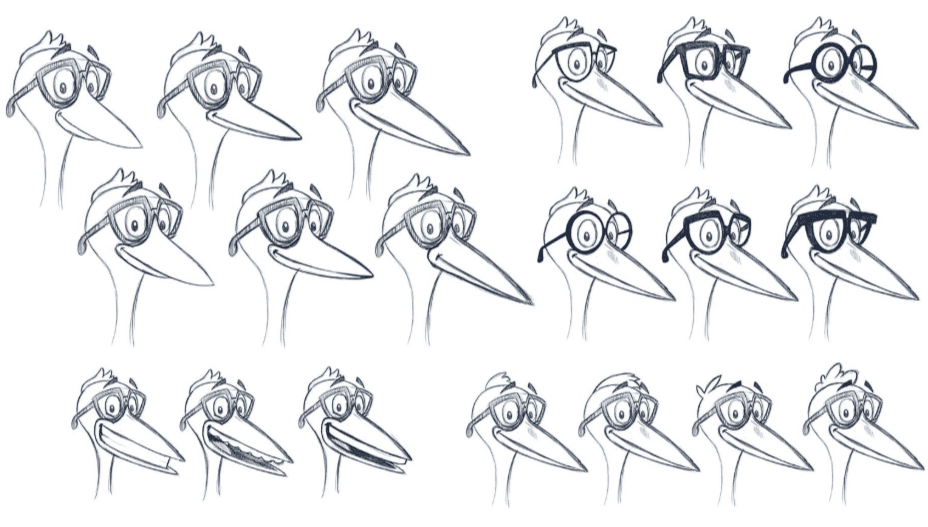
Sketches and designs of a Stork character for Parcel2Go.
Early 3D models designs of a stork character. Some of these are wireframe, showing the progression from sketch through to modelling.

Parcel 2 Go

Parcel 2 Go

The example above is a really good case study of how we work with a client to take their character from some doodles, or (these days) generated thoughts, into fully rigged and moving 3D characters. In many instances the biggest part of our work is giving them some character, and making them likeable. As you can see from the sketches, some of the ideas we had were actually a bit creepy. But that's the beauty of being able to sketch and iterate quickly. It means you aren't too far down the line when you spot things.

A project like this can move quickly. We were through the sketches in a couple of weeks, and once approved into the modelling and rigging (putting the bones and the movement in).

You can see the full project on our Parcel2Go case study.

Sketches of character designs for a Rhino that we designed for Regency Glass

Regency Glass

Regency Glass

Above is one of our most loved characters, Reg the Rhino. Regency Glass brought the idea to us as the host of a series of internal training videos. Based just outside the city, a Manchester studio was a good fit for them. As you can see in our case study, it grew wings (or rather, in this instance, horns!). The images above show the development through the idea phase. And the video below is a short clip from the tests we produced.

The testing is a really important phase. It's where we start to get a feel for the character and see how it looks moving and breathing. It's one thing seeing it on a page, it's very different once you see it moving around.

This project took several months, as it was a brand asset that will live with the company for many years. We also wanted to make sure all the key stakeholders were on board.

FAQs | Character Design

How long does it take?

The case studies on this page show the different ends of the spectrum. We always start off with the sketches as it allows us to move quicker. If we can get these signed off, we can move into the full design, and/or 3D modelling quickly.

A character can be designed and complete in a month. More complex, with more feedback can take 2 to 3 months.

What affects the cost?

Once designed, we need to turn it into a character that can move, smile, talk, sing….whatever is neede. This is where we start to discuss what form it's going to live in. 2D, 3D, Stop motion….

Does 3D or 2D change things?

Yes. A 2D character is quicker to draw and realise than a 3D character is to model.

Do we own the IP?

This can be a tricky area, but one we want to discuss from the outset.

Should I get a 2D character because it's cheaper?

The inital set up cost is cheaper. And it's quicker. However one thing that isn't often known or discussed, is the ongoing value of a 3D character. Although it takes longer and costs more to set up, once it's built, we have a far more flexibile asset.

You can re-use the poses, duplicate animations, change camera angles. It's very adaptable. 2D is also, but requires more work for each shot.

One to discuss at the outset. The end use determines which is best for you.

How long does it take?

The case studies on this page show the different ends of the spectrum. We always start off with the sketches as it allows us to move quicker. If we can get these signed off, we can move into the full design, and/or 3D modelling quickly.

A character can be designed and complete in a month. More complex, with more feedback can take 2 to 3 months.

What affects the cost?

Once designed, we need to turn it into a character that can move, smile, talk, sing….whatever is neede. This is where we start to discuss what form it's going to live in. 2D, 3D, Stop motion….

Do we own the IP?

This can be a tricky area, but one we want to discuss from the outset.

Does 3D or 2D change things?

Yes. A 2D character is quicker to draw and realise than a 3D character is to model.

Should I get a 2D character because it's cheaper?

The inital set up cost is cheaper. And it's quicker. However one thing that isn't often known or discussed, is the ongoing value of a 3D character. Although it takes longer and costs more to set up, once it's built, we have a far more flexibile asset.

You can re-use the poses, duplicate animations, change camera angles. It's very adaptable. 2D is also, but requires more work for each shot.

One to discuss at the outset. The end use determines which is best for you.

Have a project in mind?

By submitting, you agree to our Privacy Policy.

Let’s talk.

Tell us about your project—whether it’s from concept, or if you're already at storyboard stage….we'd love to know more.

Have a project in mind?

By submitting, you agree to our Privacy Policy.

Let’s talk.

Tell us about your project—whether it’s from concept, or if you're already at storyboard stage….we'd love to know more.

Our Socials

Our Socials

© 2026 MightyGiant. All rights reserved.

© 2026 MightyGiant. All rights reserved.

© 2026 MightyGiant. All rights reserved.