Experiments in colour and shape
Colour Theory

Founder
Colour Theory
Founder
We’re always looking into ways to boost our workflow processes whilst maintaining or better yet, improving the quality of our work. The nature of our work means colour and shape are significant factors in our projects. Based on some ongoing team discussions we decided to set ourselves a project that had a clear objective. Leveraging the ACES colour system and integrating EXRs into our workflow. A lot of capital letters we appreciate. You don’t need to fully understand all those…the main thing is the goal. To streamline the journey from 3D creation into post-production, enhancing efficiency and simultaneously exploring the potential of ACES to elevate our visual output.
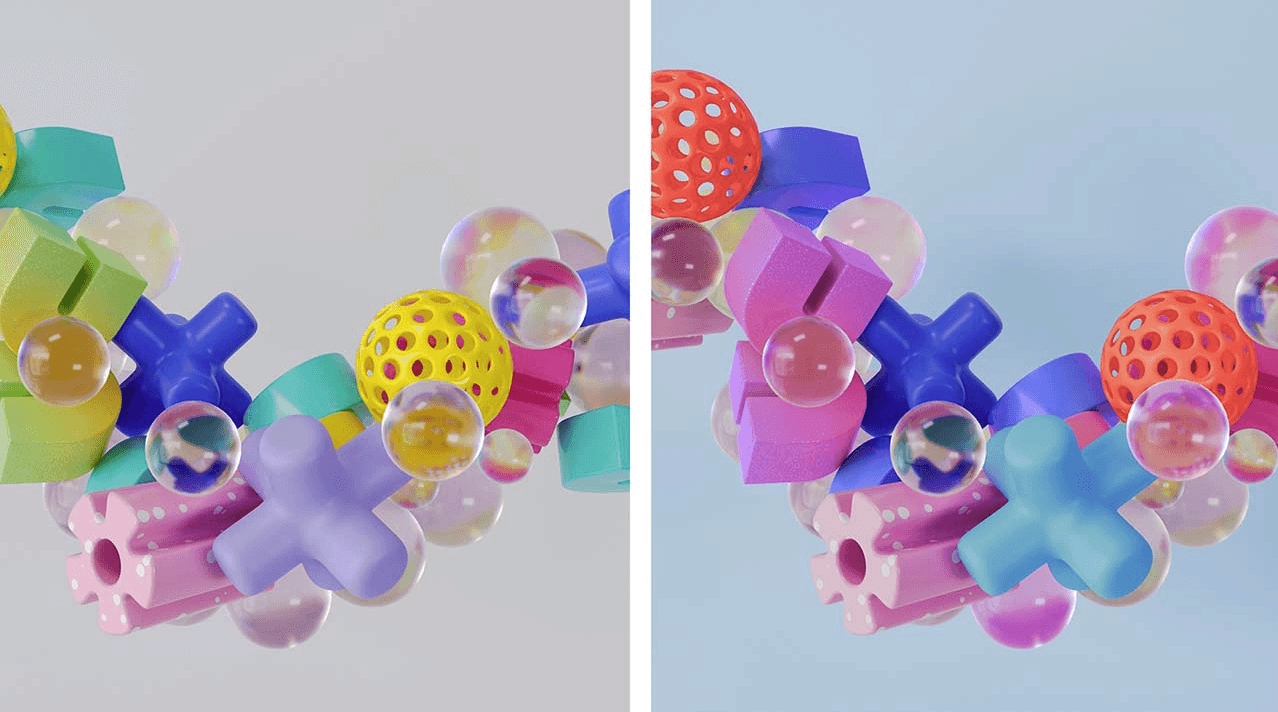
We built our project around using dynamic shapes that float in a wave-like formation to get interesting interactions and visuals. We wanted to delve into how the ACES system worked with a palette that used a variety of colours from across the spectrum, which would enable us to see whether our approach could yield improved tonal consistency and overall control.
A key area was exploring the effect ACES would have with different materials. Especially ones that would end up interacting with each other through the animation. Plastics and glass helped us see how well different reflectivities, transmissions and dispersions within Redshift would work in post through the ACES system.
Comprehensively integrating ACES into the C4D project through the project’s colour management settings, proved to be a straightforward process. Previously, ACES wasn’t widely familiar. But it’s now becoming more seamlessly incorporated into design software, and establishing itself as an industry standard.
With everything ready to output we could now explore the benefits of EXR’s further. The different compression methods definitely helped to significantly reduce the file sizes – a big help when rendering out lots of image sequences.
Employing EXR files also facilitated smoother handovers for post-production. We also now have the addition of using mattes (a way to isoltate elements) giving even more control.
On many projects, even the smallest details might need tweaking. Lighting and textures in 3D software can affect colour. When a brand demands the colour to match, we now have this flexibility. We had this recently on a project for a well known games company (that uses symbols on it’s controllers!). Matching these colours was key, and this technique allowed us to do this.
Overall we feel that this R&D project was a great success on multiple levels. It refined our workflow by streamlining the 3D to Post production process, and maintained the quality of the animation. Consequently the efficiencies gained using this method would only increase the productivity for the final delivery to the client, which can only be a win win for all. Now that there’s a tried and tested workflow in place, we’ll definitely be exploring this system more and seeing if there’s any more developments to be gained.