Sometimes you have to Dare to be Mighty
Some products are easy to film. You point a camera at them and let them speak for themselves. Dare to be Mighty is about the other kind: the ones that live in the cloud, behind a login, or in a process nobody can see. Our brief was to tell the story of a technology product without showing it and without naming it. With nothing to point a camera at, we had to make the idea visible, and that's the job animation is built for.
Client & Sector
Client: MightyGiant
Sector: Technology, SAAS
The Challenge
Animation is a fantastic tool for explaining the abstract, the complex and, sometimes, the absurd. This project needed all three.
Explainer videos usually lean on something solid: a product shot, a UI walkthrough, a logo reveal at the end. This brief took all of that away. We couldn't show the product, couldn't name it, and couldn't fall back on screen recordings. What was left was the idea underneath: what the technology does for people, and why it matters.
That shaped the real challenge. Without visual anchors, an abstract story can easily turn vague, with pretty shapes moving around and nothing for an audience to hold on to. We had to find a visual language concrete enough to follow and open enough to carry an idea that has no physical form. It also had to work without a voiceover propping it up.
The brief in one line: Make people understand and feel the value of something they never actually see.
Our Approach
We didn't jump straight into design. With a story this abstract, the thinking comes first, and the visuals have to come out of the narrative. That's often the bit we love the most.
We brought in Jacob Brodmann of Honest Days Work as story partner from day one. Working together on storybuilding and ideation, we pulled the product's purpose apart until we found a human, metaphorical story that could stand in for it. The rule was that the audience shouldn't need to know what the product is to understand what it means.
The Craft
This is the process behind the film, step by step. It's the same structured approach we use whenever the subject is something you can't simply film.
1. Storybuilding and ideation With Jacob Brodmann (Honest Days Work), we turned the brief into a narrative spine: a beginning, a tension and a resolution that mirror what the product does, told entirely through metaphor.
2. Moodboards and sketches Before committing to a look, we explored several visual worlds through moodboards and rough sketches, covering colour, shape language, texture and pace. This is where an abstract idea first gets a visual identity and where the client can react to a feeling rather than a paragraph.
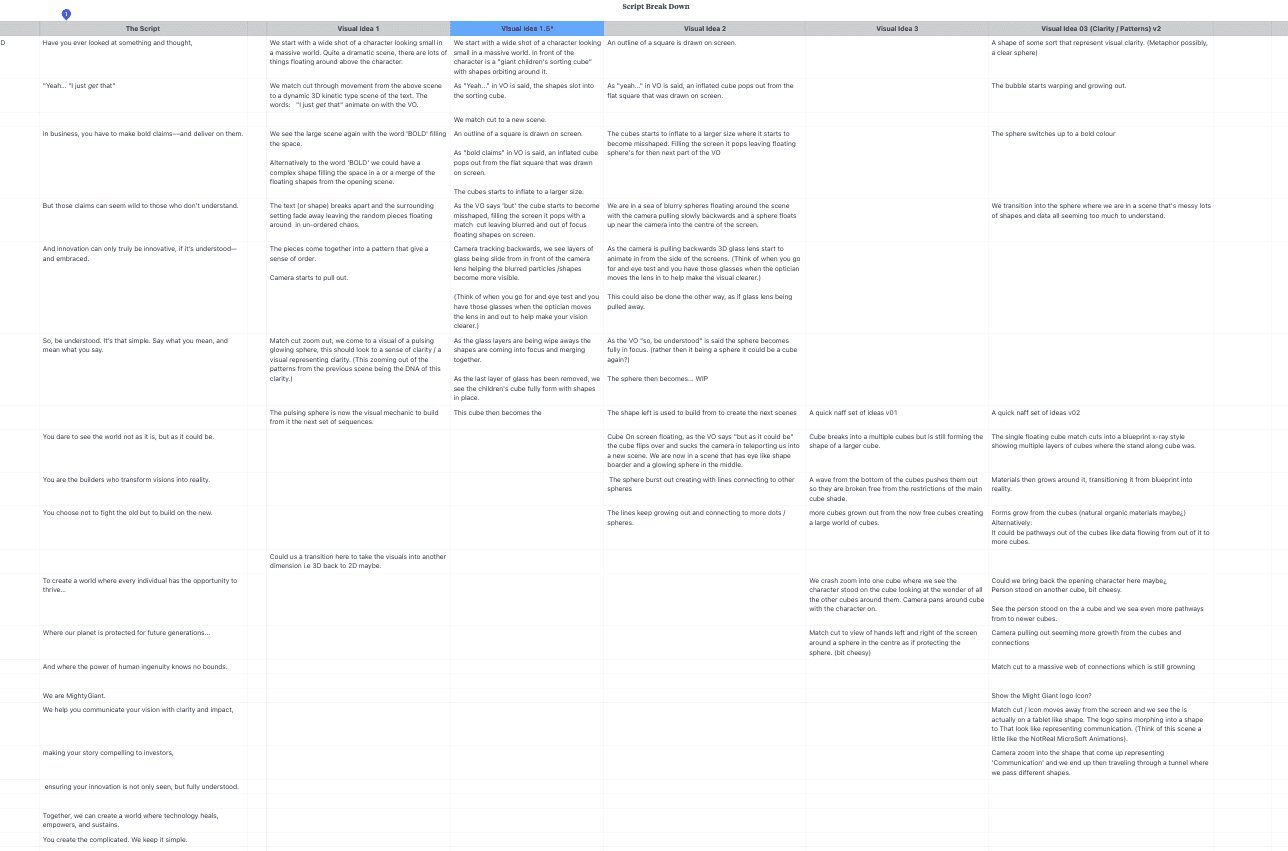
3. Script blocking into actions We broke the script down line by line and gave each moment a physical action, something that moves, transforms or reacts on screen. Blocking at this stage makes sure every beat of the story has a visual job to do, so nothing is just decoration.
4. The motion script The blocked actions became a motion script, a working document that sets out what happens on screen, when, and how it moves from one idea to the next. It sits between the written script and the storyboard and gives everyone a shared plan for timing and transitions before any frames are drawn.
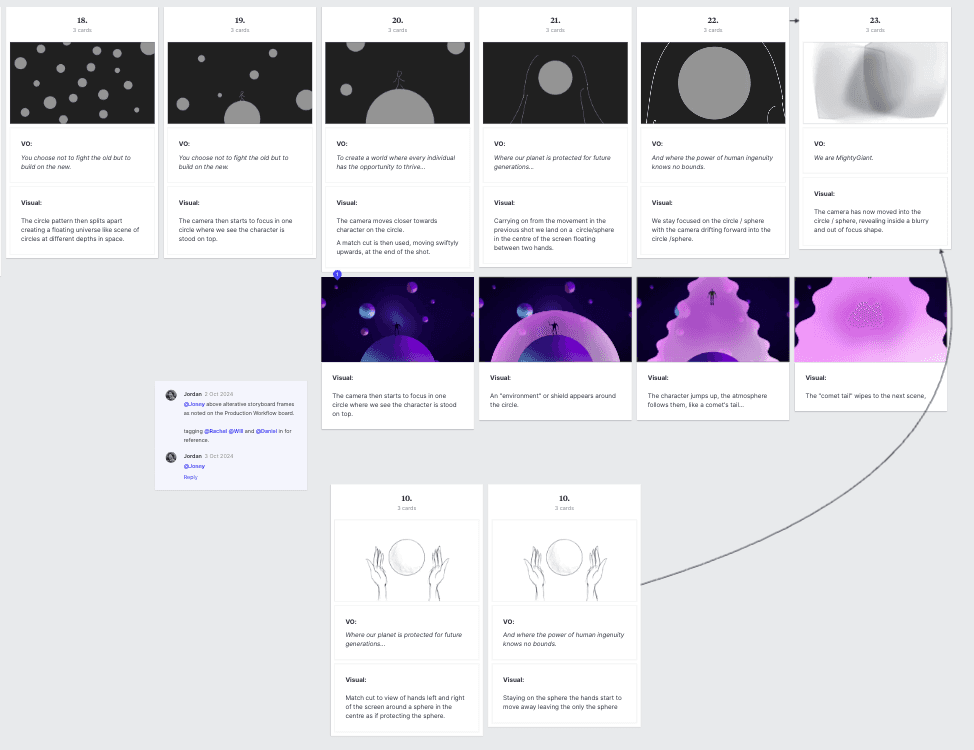
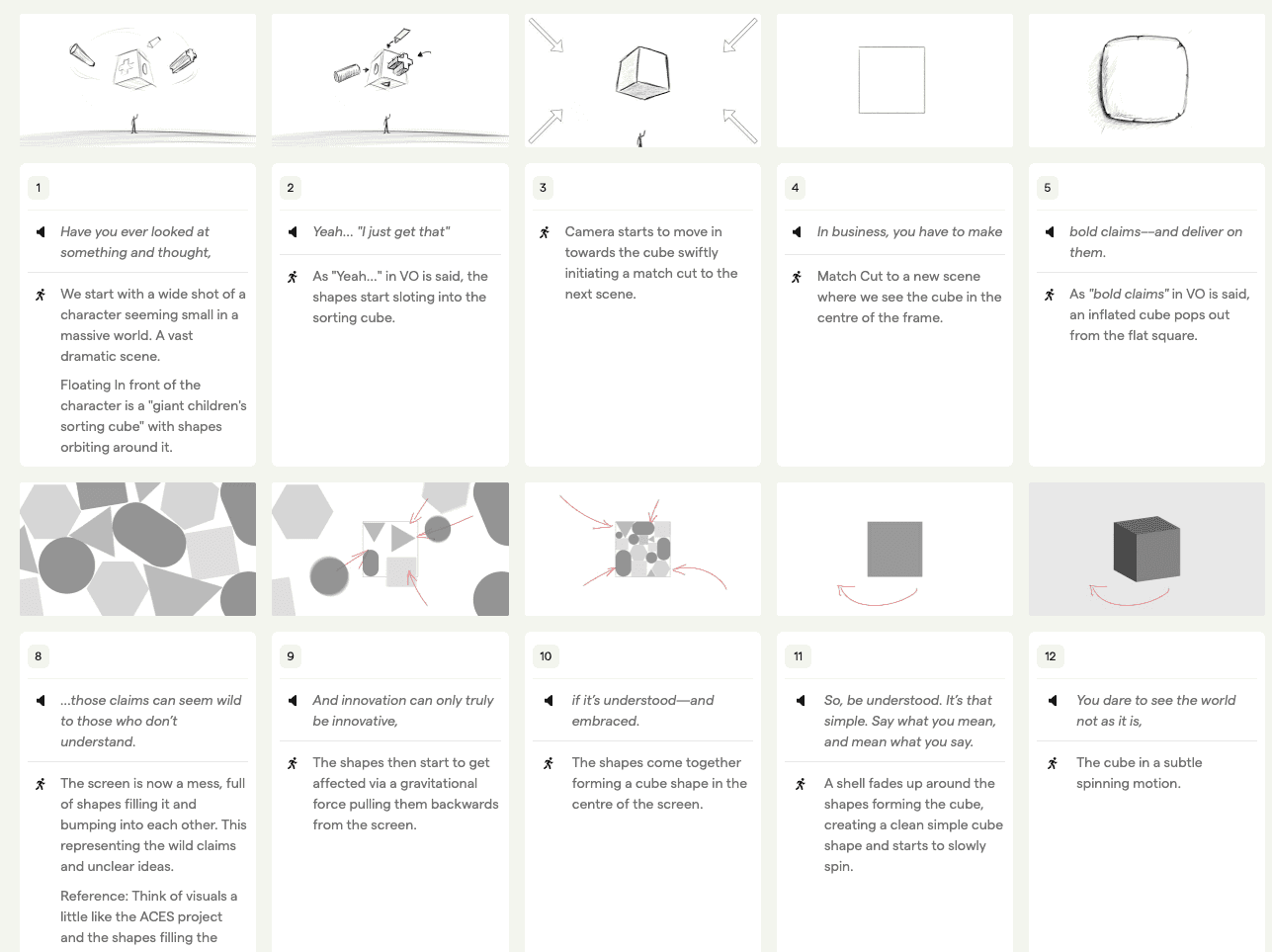
5. Storyboards: detailed or abstract, depending on the moment Not every scene needs the same level of definition. Where the story depended on clarity, we boarded in detail. Where it depended on feeling and flow, we kept the boards looser so the motion could lead. Matching the board to the job kept the process quick without losing control.
Can we help?
Got an idea bubbling, or a product that's tricky to explain? Whether it's abstract, complex or a little bit absurd, we'd love to hear about it. Click below and drop us a line.